
AI Can't Replace Your Designer. But It Might Replace Your Bad One.
AI tools are raising the floor and making the ceiling matter more.
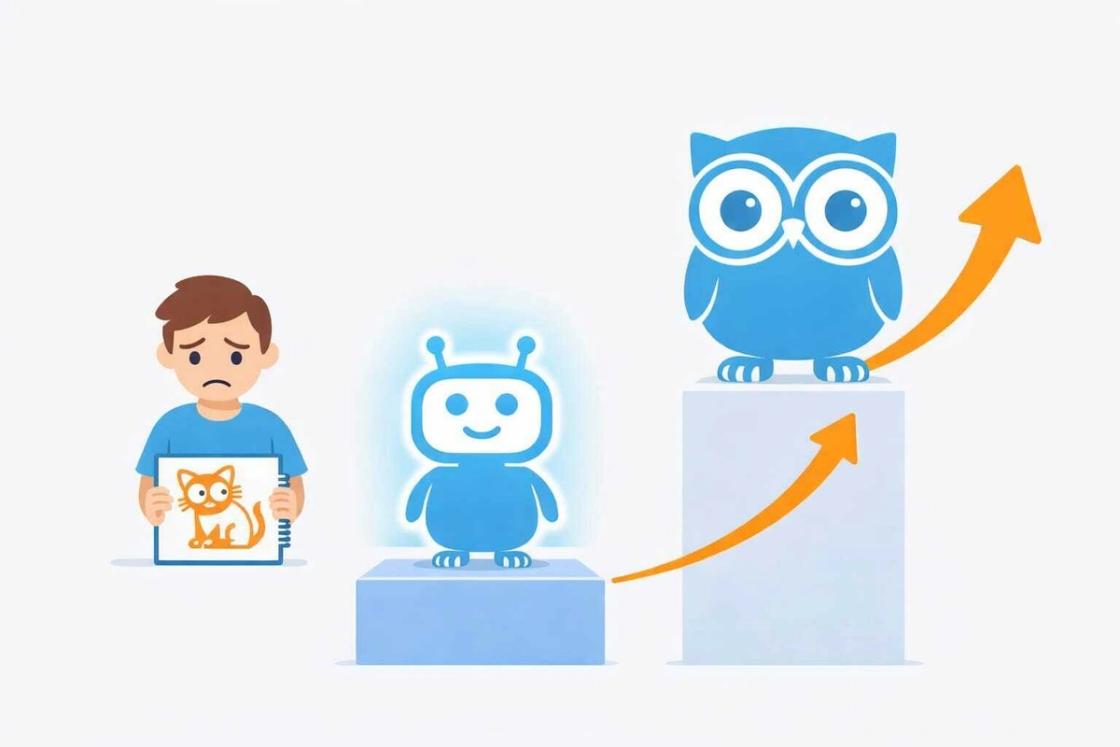
There’s a conversation happening in every creative department right now: is AI going to replace designers? Short answer: no. Longer answer: it depends on what kind of designer we’re talking about.
If your designer’s job is primarily pushing pixels — resizing images, swapping colors, making slight variations of the same layout — then yes, AI is coming for that role. But if your designer is someone who solves business problems through visual thinking, who understands why a layout works and not just how to build one, who can look at a brief and know that the client is asking the wrong question — that person just got more valuable, not less.
What AI Is Good At
Generating options quickly. Exploring color palettes. Removing backgrounds. Resizing assets for different platforms. Creating variations of a layout. Producing generic but usable illustrations. Mocking up concepts that would take a human designer hours.
These tasks used to be a significant part of a designer’s day. For junior designers especially, production work — resizing, reformatting, creating variations — was a big chunk of the job. AI handles this faster than any human can.
Here’s a specific example from our own studio. We used to spend 2–3 hours per project exploring color palette directions. Now we use AI to generate 30–40 palettes in minutes, and our designers spend their time evaluating which ones work for the brand and why. The exploration phase compressed from hours to minutes. The thinking phase stayed the same.
AI is also genuinely useful for the early divergent phase of design — when you want lots of rough ideas on the table before committing to a direction. A designer can now explore twice as many concepts in half the time. That’s not a threat to the profession. That’s a superpower for professionals who know how to wield it.
What AI Can’t Do
Make decisions. That’s it. That’s the whole answer.
AI can generate 50 homepage layouts. It can’t tell you which one will work for your audience. It can create 200 logo variations. It can’t tell you which one will hold up at 16 pixels as a favicon, look right on a billboard, and still feel authentic to your brand in five years.
Design is not making things. Design is choosing which things to make and why. The thinking, the rationale, the strategic alignment. That requires understanding the business, the audience, the competitive landscape, and the goals. AI has none of that context unless a human provides it.
Taste
Context
Judgment under constraints
What AI Does
- Generates options quickly
- Explores color palettes and variations
- Removes backgrounds and resizes assets
- Produces generic illustrations
- Creates statistically likely outputs
What Designers Do
- Makes strategic decisions about which option works
- Understands brand context and competitive landscape
- Solves business problems through visual thinking
- Brings taste, judgment, and empathy
- Navigates constraints and client relationships
Design was never about making things pretty. It was about making things work. AI can make things pretty faster than ever. Making things work still requires a human.
The Floor and the Ceiling
AI is raising the floor. The minimum viable quality for a logo, a social graphic, or a website layout just went up because anyone with an AI tool can generate something passable. The $200 logo from a marketplace designer now competes with the $0 logo from an AI generator. Both are mediocre. Both lack strategic thinking. But one is free.
This eliminates the market for commodity design. Generic logos, template customization, basic social graphics — if the work didn’t require much thinking before, AI can do it cheaper and faster.
But the ceiling — the upper bound of what great design can deliver — just got higher. Designers who think strategically, who bring taste, judgment, and the ability to solve business problems through design, are more valuable than ever. Because now they can move faster. They can explore more directions. They can spend less time on production and more time on the decisions that actually matter.
The gap between good design and commodity design is widening. Businesses that recognize this and invest in the strategic end will pull further ahead. Businesses that see AI as a replacement for design thinking will get exactly what they pay for: something that looks fine and does nothing.
What This Means at Each Level
For business owners
For marketing teams
For designers
How We Use AI in Our Design Process
We’re not theorizing about this. We use AI tools in our studio every day. Here’s what that actually looks like.
During research, we use AI to analyze competitor visual languages at scale — pulling trends, identifying gaps, and mapping the visual landscape our client is entering. During exploration, AI helps us generate rough concepts faster so we can present more directions in the initial round. During production, AI handles the repetitive tasks: resizing for different platforms, generating color variations, creating responsive breakpoints.
But the strategy, the creative direction, the decision about which concept to pursue and why, the client presentation that explains the rationale, the quality control that ensures every pixel serves the brand — that’s all human. And it always will be.
AI made us faster. It didn’t make us unnecessary. If anything, it freed us up to do more of the work that actually moves the needle for our clients. The thinking work. The hard work. The work that matters.
The Bottom Line
AI can’t replace your designer. But it can replace the parts of design that didn’t require a designer in the first place.
The companies that understand this distinction will use AI to amplify their creative teams. The companies that don’t will fire their designers, generate everything with AI, and wonder why their brand looks identical to every other company that did the same thing.
Design was never about making things pretty. It was about making things work. AI can make things pretty faster than ever. Making things work still requires a human who understands the problem, the audience, and the strategy. That’s what you’re paying for when you hire a good designer. And that’s the one thing AI can’t automate.