
AI Fatigue Is Real and Your Audience Has It.
Everyone's tired of AI everything. Here's what that means for your brand.
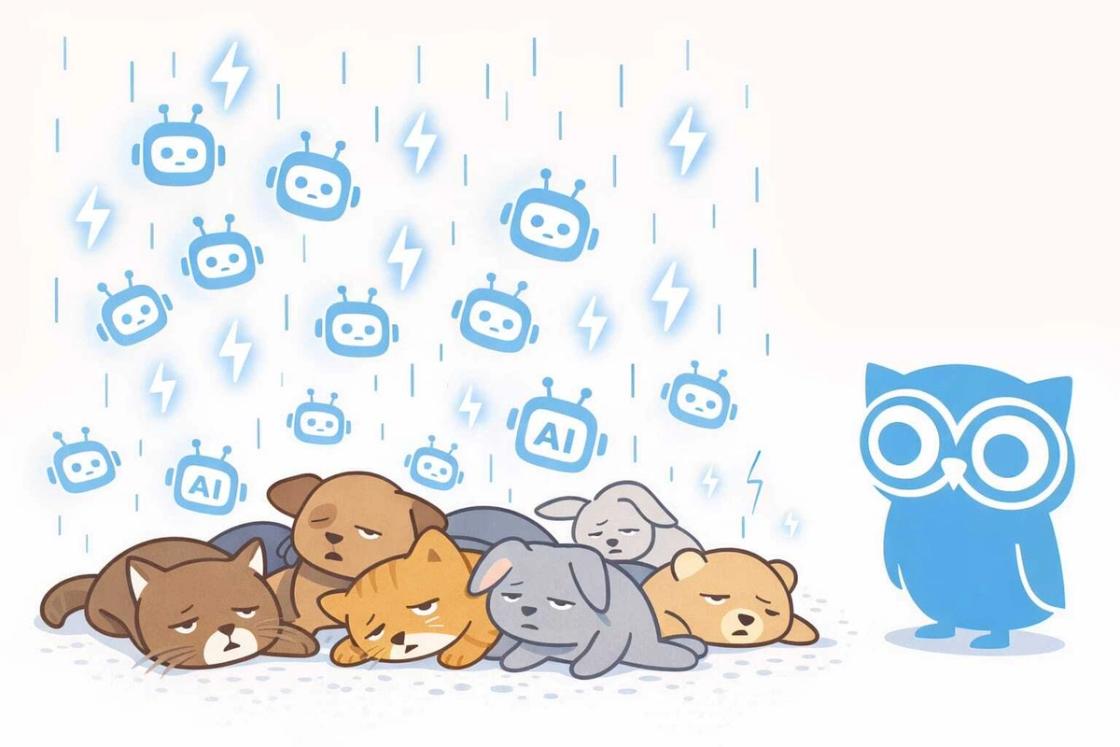
Open your inbox right now. Count how many emails mention AI in the subject line. Check your LinkedIn feed. Count the posts about “leveraging AI” or “the future of AI in [industry].” Now imagine you’re your customer, seeing this same flood from every company, every day, for the past two years.
Remember when every company had to have a blockchain strategy? Then it was the metaverse. Now it’s AI. And look, AI is actually useful. Way more useful than whatever the metaverse was supposed to be. But the hype cycle is doing what hype cycles do: making people exhausted.
0%
of consumers say they’re tired of AI-branded products
0%
trust a brand less when it leads with AI messaging
0x
more likely to engage with human-forward content
Your customers are seeing “AI-powered” stamped on everything from toothbrushes to tax software. They're getting emails that obviously came from ChatGPT. Their LinkedIn feeds are full of AI-generated thought leadership that all makes the same three points in the same tone. They’re over it.
And it’s not just a feeling. Survey data backs it up. Consumers increasingly report lower trust in brands that lead with AI messaging. The word “AI” in product descriptions is starting to function less like a feature and more like a warning label.
The Backlash Is Already Happening
Consumers are actively seeking out human-made content, handmade products, and brands that feel like actual people run them. “Not made with AI“ is becoming a selling point. Etsy sellers are adding “100% human created“ to their listings. Restaurants are advertising “real chef, no robots.“ It's a little silly, but the sentiment is real.
For B2B companies, the backlash is subtler but just as real. Decision-makers are getting pitched by companies whose websites, case studies, and proposals all sound identical because they were all generated by the same tools. When everything sounds the same, nothing stands out. And when nothing stands out, deals stall.
There’s also a credibility problem. When a prospect reads your case study and it has that unmistakable ChatGPT cadence — the tidy three-point structure, the upbeat filler, the conspicuous lack of anything specific — they start wondering what else is fabricated. Did you actually get those results? Does your team actually have that expertise? AI content doesn’t just bore people. It makes them suspicious.
How to Spot AI Fatigue in Your Own Audience
1
Check your engagement trend
You’re publishing more content than ever but engagement metrics are flat or declining. More volume with less human effort often means less human connection in the output.2
Run the swap test
Pull up your last five blog posts next to your top three competitors’. If you swapped the logos, would anyone notice? If not, AI fatigue is your specific problem.3
Listen to your sales team
When prospects can’t differentiate you from competitors, the problem is messaging. When every company uses the same AI tools, convergence is inevitable.
What This Means for Your Marketing
Stop leading with AI as your differentiator. Nobody cares that you “use AI” anymore. Everyone uses AI. It’s like bragging about using email.
Instead, lead with outcomes. Lead with your point of view. Lead with work that's clearly thoughtful and specific to the person reading it. Use AI behind the scenes to work faster and smarter, but don't make it the headline.
The brands that thrive through AI fatigue will be the ones that use these tools without making them the main character. Your audience wants to feel like they’re talking to people, not platforms.
Here’s a practical framework. Before you publish anything, ask three questions:
- Would a competitor’s AI produce something nearly identical?
- Does this contain a specific opinion or insight from our actual experience?
- Would I find this interesting if I wasn’t the one who wrote it?
If you can’t answer those well, the piece isn’t ready.
AI-Forward Messaging
- “Our AI-powered platform delivers...”
- Leading with the technology
- Generic, tool-driven language
- Sounds like every competitor
- Triggers skepticism
Human-Forward Messaging
- We solve [specific problem] faster
- Leading with outcomes and results
- Specific, experience-driven language
- Sounds like your brand
- Builds trust and credibility
The best use of AI in marketing is the use nobody notices. When AI is the first thing you mention on your homepage, it’s just noise.
What to Do With Your Website and Brand Messaging
Audit your website copy. How many times does it mention AI? If it’s a tool you use, not your product, stop leading with it. Lead with the problem you solve and the results you deliver. Your customers don’t care about the tools in your kitchen. They care about the meal.
This is especially important for your homepage and service pages. If those pages read like every other AI-buzzword-laden website in your category, you’ve lost the differentiation battle before it started. A good brand strategy establishes what makes you different — and “we use AI” isn’t it anymore.
The Irony
The best use of AI in marketing might be the use nobody notices. When AI helps you research faster, test more angles, and produce better work, that’s genuinely valuable. When AI is the first thing you mention on your homepage, it’s just noise.
We use AI in everything we do. For research, for scaffolding ideas, for speeding up production. We just don’t think that’s interesting to our clients. What’s interesting is the work that comes out of it — the campaigns that actually convert, the websites that actually perform, the brand strategies that actually differentiate.
The companies that will win the next five years aren’t the ones shouting loudest about AI. They’re the ones quietly using it to do better work while their competitors are still writing blog posts about “leveraging AI to transform the customer experience.” Nobody wants to read that. Including you.
Audit your website and marketing materials today. Count how many times you mention AI. If it’s a tool you use and not your product, remove it from your headlines and lead with outcomes instead.